


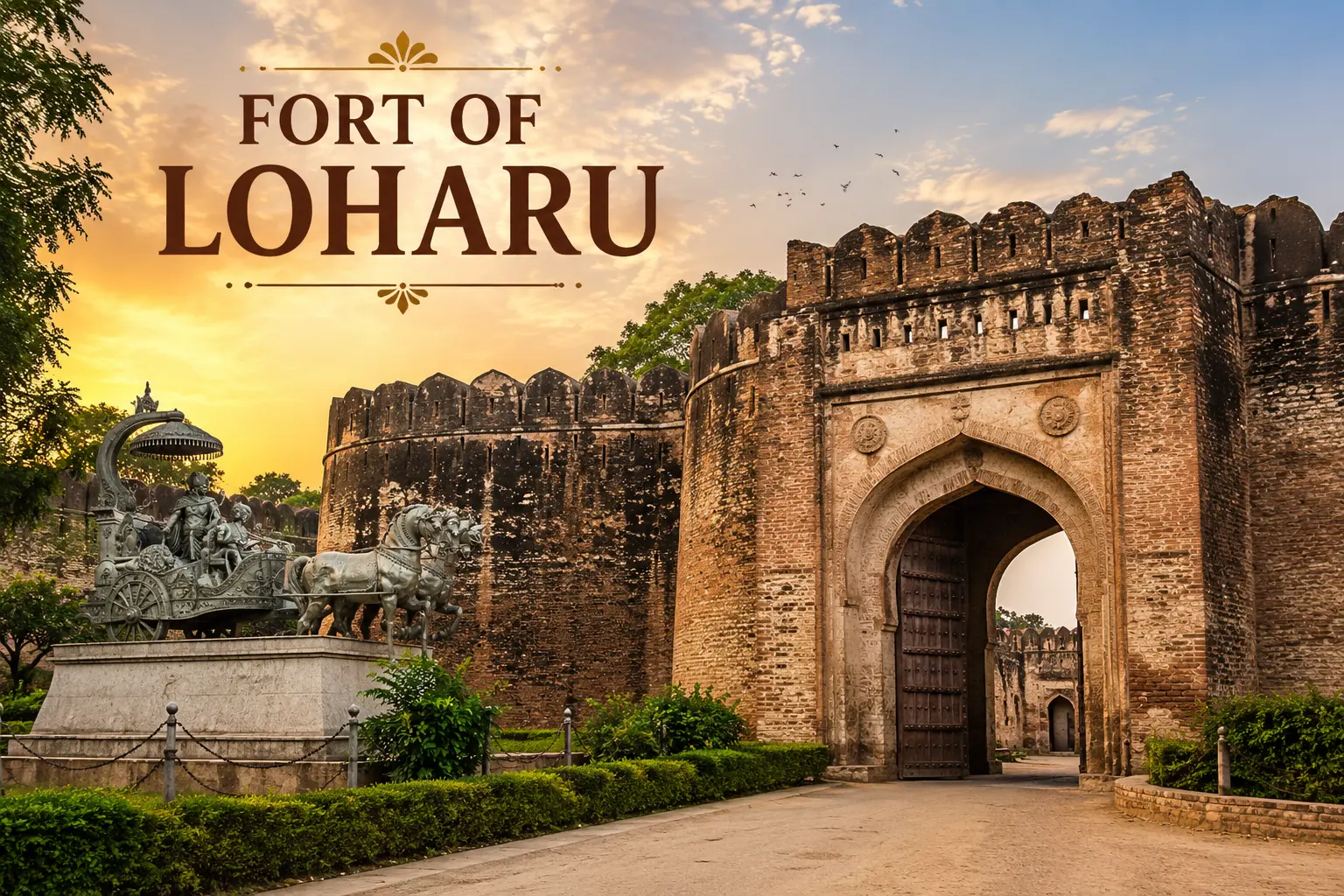

Nestled in the historic town of Loharu in the Bhiwani district of Haryana, the Fort of Loharu is a remarkable reminder of the region’s rich political and architectural heritage. Standing tall for more than four centuries, this fort has witnessed the rise and fall of kingdoms, changing rulers, and the transformation of Haryana through different historical eras. Although less explored than many of India’s famous forts, the Fort of Loharu remains an important cultural landmark that reflects the glorious past of the region.
The History of Fort of Loharu
The Fort of Loharu was built in 1570 A.D. by Arjan Singh, a Hindu Rajput ruler. During the sixteenth century, forts served as both military strongholds and administrative centers, protecting local kingdoms from invasions and maintaining law and order. Arjan Singh selected Loharu as a strategic location because it lay along important trade and communication routes connecting Rajasthan, Delhi, and the surrounding regions.
Over the centuries, the control of the fort changed hands several times. Eventually, it came under the rule of the Nawabs of Loharu, who transformed the fort into their official residence and administrative headquarters. The Nawabs made significant additions and modifications to the original Rajput structure, blending traditional military architecture with residential and royal elements. As a result, the fort today represents a unique combination of Rajput strength and Indo-Islamic elegance.
Architectural Features
The Fort of Loharu showcases a simple yet impressive architectural style that emphasizes both security and functionality. One of its most distinctive features is that the fort has only one main entrance, located on the eastern side. This massive gateway was designed as the primary access point and served as an important defensive feature, making it easier to monitor visitors and protect the fort from enemy attacks.
The imposing doorway reflects the robust construction techniques of the medieval period. Thick walls, high fortifications, and spacious courtyards were carefully planned to withstand sieges while providing ample space for soldiers, administrators, and members of the royal household.
As successive rulers occupied the fort, different structures were added to the complex from time to time. Residential quarters, administrative buildings, courtyards, storage rooms, and service areas gradually expanded the original layout. These additions not only enhanced the fort’s functionality but also reflected the changing needs and lifestyles of its rulers.
The Nawabs’ Influence
The arrival of the Nawabs brought significant cultural and architectural changes to the fort. While retaining its defensive character, the complex gradually evolved into a royal residence that displayed elegance alongside strength. The Nawabs incorporated architectural features inspired by Mughal and Indo-Islamic traditions, adding decorative elements and improving the living quarters.
The Fort of Loharu thus became more than just a military installation—it served as the political and administrative center of the Loharu State, where important decisions regarding governance, diplomacy, and regional affairs were made.
Cultural and Historical Importance
The Fort of Loharu occupies an important place in Haryana’s history because it represents the transition from Rajput rule to the Nawabi era. It reflects the political evolution of the region and demonstrates how different cultures and rulers contributed to its architectural heritage.
Unlike many forts that were constructed entirely under a single dynasty, the Fort of Loharu bears the marks of multiple periods of development. Every addition to the complex tells a story of changing rulers, evolving architectural styles, and the shifting priorities of governance.
For historians and architecture enthusiasts, the fort offers valuable insights into medieval military planning, regional administration, and the blending of Rajput and Indo-Islamic architectural traditions.
Visiting the Fort Today
Today, the Fort of Loharu continues to attract visitors interested in Haryana’s lesser-known historical monuments. Though parts of the structure have weathered the passage of time, its massive entrance, sturdy walls, and historic layout still convey the grandeur of its past.
Visitors can walk through the historic gateway, explore the fort complex, and admire the blend of architectural styles that developed over several centuries. The peaceful surroundings also make it an ideal destination for photography, heritage walks, and history enthusiasts looking to discover hidden gems beyond the state’s more popular tourist attractions.
Conclusion
The Fort of Loharu stands as a proud symbol of Haryana’s rich historical legacy. Built by Arjan Singh in 1570 A.D. and later expanded by the Nawabs of Loharu, the fort beautifully combines Rajput military architecture with Nawabi elegance. Its massive eastern gateway, evolving architectural features, and historical significance make it one of the most fascinating heritage sites in Bhiwani district.
For travelers seeking to explore Haryana beyond its well-known destinations, the Fort of Loharu offers a captivating journey into centuries of history, architecture, and royal heritage, preserving the stories of rulers who shaped this remarkable region.