
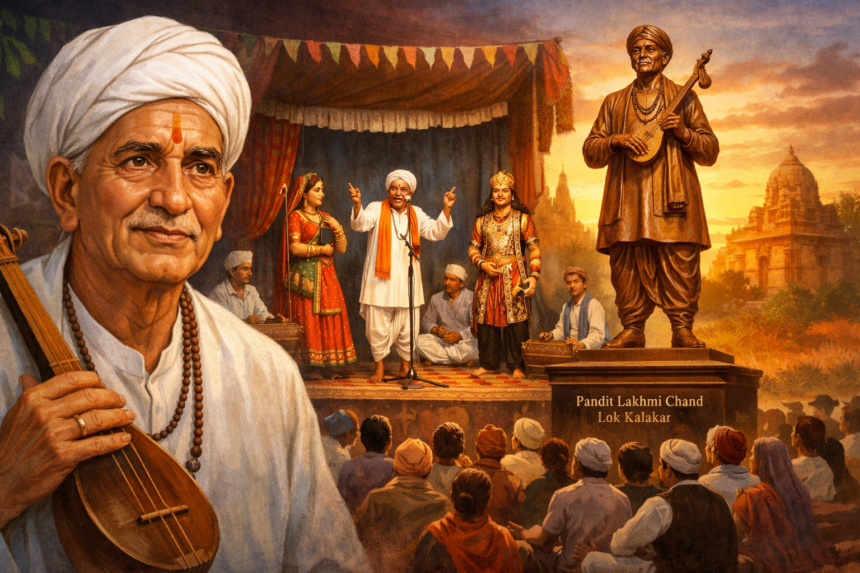
In the vibrant cultural history of India, regional artists have played a crucial role in shaping local identities and preserving traditions. Among them, Pandit Lakhmi Chand holds a special place as one of Haryana’s greatest cultural icons. Known as the “Shakespeare of Haryana,” he transformed the traditional folk theatre form of saang into a powerful medium of storytelling, education, and social reform. From a student’s perspective, his life is not just inspiring but also deeply relevant in understanding the value of dedication, creativity, and cultural pride.
Early Life and Background
Pandit Lakhmi Chand was born in 1903 in Janti Kalan village in present-day Sonipat district of Haryana. He came from a modest family, and his early life was marked by financial hardships. Unlike many literary figures, he did not receive formal education. However, his natural intelligence, strong memory, and keen observation skills allowed him to learn from his surroundings.
As a student, what stands out in his early life is his ability to turn limitations into strengths. Without textbooks or formal schooling, he absorbed knowledge from folk traditions, oral storytelling, and everyday experiences. This unconventional learning journey makes his achievements even more remarkable.
Entry into Saang and Artistic Development
Lakhmi Chand’s interest in music and performance began at a young age. He was drawn to saang, a traditional folk theatre form that combined drama, music, and dialogue. Determined to master this art, he joined a saang troupe, where he learned the techniques of acting, singing, and storytelling.
This phase of his life was a turning point. Through constant practice and observation, he developed a unique style that distinguished him from other performers. He eventually started writing his own saangs, showcasing not only his artistic talent but also his deep understanding of human emotions and social issues.
Major Works and Themes
Pandit Lakhmi Chand’s saangs were rooted in mythology, history, and social life. Some of his most famous works include Raja Harishchandra and Satyavan-Savitri. These stories were not just performances but moral narratives that emphasized values such as truth, sacrifice, devotion, and righteousness.
What makes his work exceptional is its simplicity and depth. He used the Haryanvi language in a way that was easily understood by common people, yet his messages carried profound philosophical meaning. As a student, I find it fascinating how he could educate and entertain at the same time, making learning a natural and engaging process.
Contribution to Haryanvi Language and Culture
One of Lakhmi Chand’s greatest contributions was the elevation of the Haryanvi language. At a time when regional languages often lacked recognition, he enriched Haryanvi with poetic expression and cultural significance. His works helped preserve local traditions and gave people a sense of identity and pride.
Through his saangs, he also documented the social and cultural life of Haryana. His performances became a mirror of society, reflecting both its strengths and its challenges. For students, this highlights the importance of cultural preservation and the role of art in shaping collective identity.
Role as a Social Reformer
Beyond entertainment, Lakhmi Chand used his art as a tool for social reform. His performances often addressed issues such as inequality, moral corruption, and social injustice. By presenting these themes in a relatable manner, he encouraged audiences to reflect on their behavior and beliefs.
His ability to influence society through art is particularly inspiring. It shows that creativity can be a powerful means of bringing about change. As students, this teaches us that knowledge and talent should be used not only for personal success but also for the betterment of society.
Challenges and Struggles
Despite his success, Lakhmi Chand’s journey was not easy. He faced financial difficulties, societal pressures, and the physical demands of continuous performances. Yet, he remained committed to his art and continued to perform across villages.
His struggles serve as a reminder that success often comes with hardships. For students, his life reinforces the importance of perseverance, resilience, and unwavering dedication to one’s goals.
Legacy and Lasting Impact
Pandit Lakhmi Chand passed away in 1945, but his legacy continues to live on. His saangs are still performed, studied, and admired across Haryana. He is remembered not only as an artist but also as a cultural pioneer who shaped the identity of the region.
His influence extends beyond folk theatre; he has become a symbol of Haryanvi pride and artistic excellence. For students like me, his life offers valuable lessons in creativity, determination, and cultural awareness.


